How to Register Your Trademark in India?
Your brand is not all about a logo or a name. It’s the unique proposition of your business, the fingerprint that sets […]
 Exciting Offer: ₹600 FREE Shipping Credits on 1st Recharge of ₹1000. Code: FLAT600 *T&C ApplyView More Offers WELCOME BONUS: Enjoy FREE Inventory Storage for 15 Days. *T&C ApplyGet Started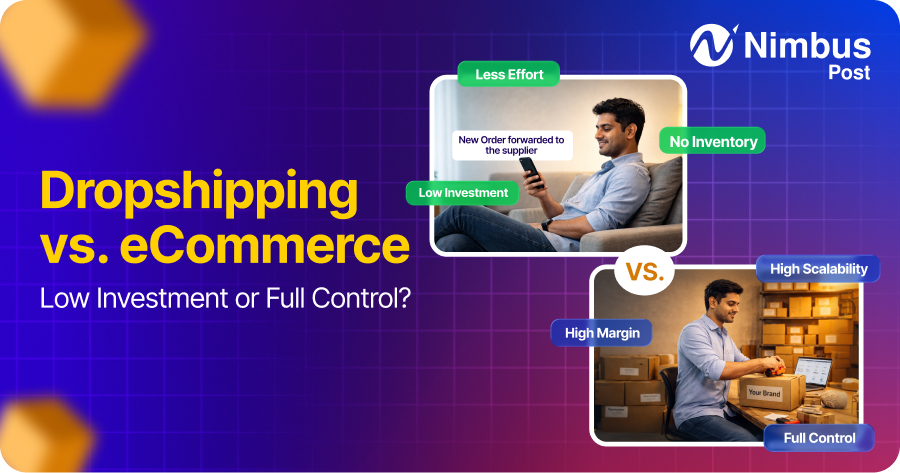
You want to start an online business. You’ve done the research. And somewhere between supplier calls and platform comparisons, you hit the big question: should you go with dropshipping or build a full eCommerce store?
Both models let you sell online. Both can be profitable. But they work very differently, and picking the wrong one for your goals can cost you time and money. This guide breaks down the real difference between dropshipping and eCommerce so you can make the right call.
eCommerce, short for electronic commerce, is the buying and selling of goods or services through online platforms. When most people say ‘eCommerce business,’ they mean a store that sources or manufactures its own products, holds inventory, and manages its own shipping and fulfillment.
Think of it like running a retail store, but online. You purchase stock, store it in a warehouse or at home, and ship orders to customers yourself or through a third-party logistics (3PL) provider.
eCommerce businesses come in many forms:
Dropshipping is a fulfillment model within eCommerce where you sell products without ever holding inventory. When a customer places an order on your store, you forward that order to a supplier who ships the product directly to the customer.
You never touch the product. You never manage stock. Your role is to run the storefront, handle marketing, and manage customer relationships.
In many ways, dropshipping is a subset of eCommerce, not a competitor to it. But the operational differences are significant enough to treat them as separate business decisions.
Here is a clear breakdown of how the two models compare across the factors that matter most to online sellers.
eCommerce requires you to purchase stock upfront. This means higher startup costs but also more control over product quality, packaging, and availability.
Dropshipping requires little to no inventory investment. You only pay for a product after a customer has already paid you. This makes it a lower-risk way to test new products or enter a market.
For sellers in India, starting a dropshipping business can require as little as ₹50,000, while a traditional eCommerce setup often demands significantly more capital for stock and storage.
eCommerce businesses typically enjoy higher margins. Buying wholesale gives you more room to mark up prices and build healthy profits per sale.
Dropshipping margins are thinner. Suppliers charge more per unit since they handle storage and fulfillment. After platform fees and marketing spend, net margins in dropshipping often fall between 10% and 30%, compared to 30% to 50% or more in traditional eCommerce.
With eCommerce, you inspect your inventory before it reaches customers. You control packaging, inserts, and the unboxing experience. This is a major advantage for D2C brands trying to build loyalty.
With dropshipping, quality control depends entirely on your supplier. Products arrive in generic or supplier-branded packaging, which limits how distinctive your brand feels to buyers.
This is where the two models diverge most visibly. In a traditional eCommerce setup, you manage shipping. You choose carriers, negotiate rates, and decide how fast orders go out the door.
In dropshipping, your supplier controls shipping speed and carrier choice. If they delay or make an error, you bear the customer service burden even though the mistake was not yours.
For Indian sellers scaling across multiple pin codes, working with a reliable courier aggregator like NimbusPost makes a real difference. Whether you’re shipping your own inventory or coordinating with suppliers, having access to 25+ courier partners from a single dashboard helps you keep delivery performance consistent, compare rates in real time, and reduce RTOs across your orders.
Dropshipping scales quickly in terms of product range. Adding new SKUs costs nothing since there is no inventory to buy. However, you are limited by your supplier’s capacity and reliability.
eCommerce scaling requires investment in inventory, storage, and fulfillment infrastructure, but it gives you more control over the outcome. Many growing D2C brands use fulfillment partners or 3PLs to handle the operational side as they expand.
Dropshipping businesses often compete on the same products from the same suppliers. Price becomes the main differentiator, which squeezes margins further.
eCommerce stores can create unique products, build brand equity, and carve out niches that are harder for competitors to replicate. Over time, this makes for a more defensible business.
Here is a side-by-side summary to help you see the differences at a glance:
Startup Cost
Dropshipping: Low (no inventory purchase needed)
eCommerce: Medium to High (inventory, storage, logistics setup)
Profit Margins
Dropshipping: 10% to 30% (thinner due to supplier markup)
eCommerce: 30% to 50%+ (bulk buying advantages)
Inventory Control
Dropshipping: None (supplier managed)
eCommerce: Full (you own and inspect the stock)
Branding Potential
Dropshipping: Limited (generic packaging by default)
eCommerce: High (custom packaging, inserts, brand experience)
Shipping Control
Dropshipping: Limited (supplier ships directly)
eCommerce: Full (choose carriers, negotiate rates)
Scalability
Dropshipping: Fast but supplier-dependent
eCommerce: Requires investment but more sustainable in the long-term
India’s eCommerce sector is on a strong growth trajectory. The market is expected to reach USD 300 billion by 2030, according to the India Brand Equity Foundation (IBEF). Dropshipping, in particular, is growing rapidly. The Indian dropshipping market was valued at USD 10.8 billion in 2024 and is projected to grow at a CAGR of 22.6% through 2033, according to IMARC Group.
This growth is being driven by affordable internet access, rising smartphone usage, and expanding digital payment infrastructure. Tier 2 and Tier 3 cities are increasingly active, which opens up new markets for both dropshippers and eCommerce sellers.
However, the success rate for dropshipping in India is estimated at just 10% to 20%. The challenge is not demand; it is execution. Reliable suppliers, fast delivery, and effective marketing are what separate winners from those who quit early.
There is no single right answer. The best model depends on your goals, your budget, and how much control you want over your business.
Choose Dropshipping If You:
Choose eCommerce If You:
Yes, and many successful sellers do. A common approach is to start with dropshipping to validate product demand, then transition to holding your own inventory once you know what sells. This lets you move fast in the early stages without over-committing capital.
Dropshipping and eCommerce are not rivals. They are different strategies for different stages and goals. What matters most is whether your fulfillment model matches your business ambitions.
If you are just getting started, dropshipping gives you a low-cost entry point. If you are building for the long term, investing in your own inventory and brand will pay off. And regardless of which path you take, getting your shipping and logistics right is non-negotiable. Customers do not care which model you use. They care that their order arrives on time.
No. eCommerce is the broader category of selling goods online. Dropshipping is one fulfillment method within eCommerce, where the seller does not hold inventory. All dropshipping is eCommerce, but not all eCommerce is dropshipping.
The primary difference between dropshipping and eCommerce lies in inventory ownership. In traditional eCommerce, you purchase and store stock yourself. In dropshipping, a third-party supplier holds the inventory and ships it directly to your customer when an order is placed.
It can be. The Indian dropshipping market is growing fast, but the success rate is estimated between 10% and 20%. Profitability depends heavily on product selection, supplier reliability, marketing strategy, and how well you manage returns and logistics.
Traditional eCommerce generally offers better margins. Buying products at wholesale prices gives you more room for markup. Dropshipping margins are thinner because you pay a premium to the supplier for handling the storage and fulfillment.
Yes. Many sellers start with dropshipping to test products and validate demand, then shift to holding their own inventory once they identify their top-selling items. This is a common and practical growth path.
In eCommerce, you manage shipping directly. You choose your courier partners, negotiate rates, and control how and when orders are dispatched. In dropshipping, the supplier ships the order, so you have limited visibility and control over delivery speed and quality. For eCommerce sellers managing their own fulfillment, platforms like NimbusPost help simplify this by offering access to multiple courier partners and a centralized dashboard to track and manage all shipments.