Innovation in Logistics: How New Technologies Reshaped the Logistics Industry
A few decades ago, finding a smartphone connection in India was more difficult than finding a person. Truck and heavy-vehicle drivers would […]
 Exciting Offer: ₹600 FREE Shipping Credits on 1st Recharge of ₹1000. Code: FLAT600 *T&C ApplyView More Offers WELCOME BONUS: Enjoy FREE Inventory Storage for 15 Days. *T&C ApplyGet Started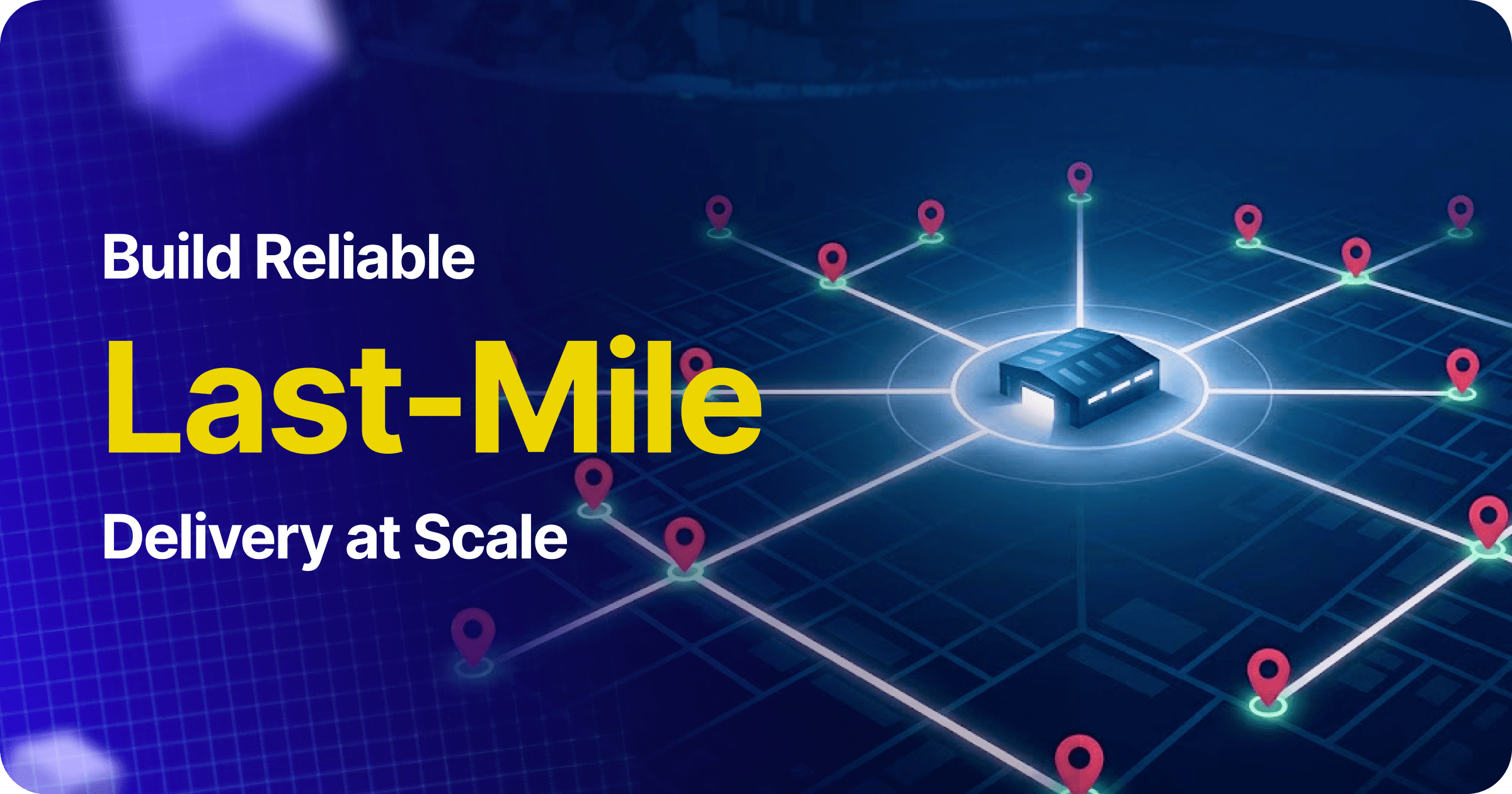
For customers, delivery ends at the doorstep. A package arrives, the status updates to delivered, and the transaction feels complete. For businesses, that final stretch is where everything is judged.
Last-mile delivery service refers to the final step in the supply chain. It is the movement of goods from a warehouse, fulfillment center, or local hub to the customer’s address. It may be the shortest physical distance in the journey, but it is often the most complex and expensive stage.
Earlier stages of logistics benefit from scale. Long-distance transport can be consolidated. Warehousing can be automated. Inventory can be planned in bulk. The last-mile, however, operates in crowded neighborhoods, unpredictable traffic, varied building access, and narrow delivery windows. It is exposed and highly visible.
In 2026, as eCommerce volumes grow and delivery expectations tighten, last-mile delivery has shifted from a backend function to a strategic lever. Delivery timelines influence checkout decisions. Real-time tracking builds confidence. Failed delivery attempts increase return-to-origin rates and squeeze margins. Reliability shapes brand perception as much as product quality.
What makes last-mile delivery uniquely demanding is its dual responsibility. It must control cost while meeting precise service promises. It must optimize routes while honoring individual delivery commitments, and scale across cities while succeeding one doorstep at a time.
For founders and operators, understanding last-mile delivery is essential. It sits at the intersection of fulfillment performance, working capital efficiency, and customer experience.
This article explores what last-mile delivery means in 2026, how the process works, why it remains challenging, and how modern last-mile solutions are evolving to meet growing business demands.
Last-mile delivery is the final step in the logistics journey, where a shipment moves from a local distribution hub to the customer’s address.
In simple terms, it is the stretch between the warehouse and the doorstep. It is where a supply chain built for scale shifts into a delivery built for precision.
A typical order travels in stages. Products move from manufacturers to regional warehouses. Orders are packed at fulfillment centers. Shipments travel through line-haul networks to city or local hubs. From there, last-mile delivery begins. Parcels are assigned to delivery personnel, routes are planned, and orders are dispatched to individual addresses.
Unlike upstream logistics, which benefit from bulk movement and predictable routing, the last-mile operates in fragmented conditions. Every address is different. Traffic changes by the hour. Customers may not be available. Cash-on-delivery payments require collection. Returns add reverse movement and extra handling.
Because of these variables, the last-mile often represents the highest cost per order in the supply chain. Capgemini Research Institute estimates that last-mile delivery can account for 41% total logistics costs in eCommerce operations.
For eCommerce businesses, this stage is more than transportation. It is the moment the brand promise becomes real. Delivery speed, communication, accuracy, and professionalism all come together at the doorstep.
Last-mile logistics is about handing a parcel to a courier. It is a coordinated system that combines allocation logic, hub efficiency, route planning, and real-time issue handling.
Once an order is packed, it must be assigned to a last-mile delivery service provider. This decision depends on delivery location, serviceability, promised timelines, cost benchmarks, and past courier performance in that region.
In 2026, allocation is largely software-driven. Systems assess SLA history, return rates, and cost performance before routing the shipment to the most suitable provider.
After line-haul transport, shipments arrive at local hubs. Here, they are sorted by delivery zone.
Efficient hub operations reduce dwell time and prevent misrouting. The goal is simple: cluster shipments intelligently so final dispatch is faster and more accurate.
From the hub, delivery routes are mapped. Planning considers distance clusters, traffic patterns, delivery windows, and rider capacity.
Modern last-mile solutions rely on algorithm-based route optimization to reduce fuel use while increasing successful deliveries per route. Efficiency must align with service reliability.
The doorstep interaction is the most visible stage. If successful, the order closes smoothly. If unsuccessful, the system shifts into exception handling. Reattempts are scheduled, confirmation calls are made, or return-to-origin processing begins.
This is where customer perception forms. A smooth delivery builds trust. A failed attempt increases cost and friction.
Delivery is no longer viewed as a backend utility. Customers evaluate it as part of the product value.
They assess brands not only on product quality but on delivery speed, tracking clarity, address accuracy, and ease of returns. In competitive categories, these factors influence repeat behavior as much as pricing.
Operationally, last-mile performance affects cash flow realization, return ratios, inventory velocity, and contribution margins. Delays slow revenue cycles. High RTO rates inflate costs and distort forecasting.
For logistics teams, last-mile delivery solution is as much a data challenge as a transport one. SLA tracking, exception visibility, cost analytics, and predictive routing define operational maturity.
For founders and growth leaders, the link is direct. Marketing creates demand. Delivery execution validates it.
Even with automation and route optimization, last-mile service remains demanding because it operates in unpredictable, real-world conditions.
Unlike bulk transport between hubs, last-mile delivery involves individual drop-offs. Each stop adds labor, fuel, and time costs. Failed attempts, re-attempts, and reverse logistics increase expenses further.
In dense urban areas, higher drop density improves efficiency. In semi-urban or remote regions, the cost per order rises due to longer distances and lower route consolidation.
Incorrect addresses, customer unavailability, cash-on-delivery issues, or restricted building access often lead to failed attempts. High return-to-origin rates double logistics costs and delay inventory recovery.
Courier performance varies by city and pin code. A partner that performs well in one region may struggle in another.
Without structured tracking of SLA adherence, delivery timelines, and failure reasons, allocation decisions become guesswork.
Delayed tracking updates or vague delivery windows increase customer frustration. In 2026, real-time visibility is expected. Poor communication now impacts repeat purchases as much as delivery speed.
Last-mile logistics plays different roles depending on the business model.
In eCommerce, shipment volumes are high, order values are smaller, and return rates are elevated. Customers expect fast delivery and detailed tracking. Speed and experience drive outcomes.
In B2B, shipments are larger, deliveries are often scheduled, and documentation accuracy matters more than extreme speed. Reliability and compliance outweigh immediacy.
As order volumes increase, manual coordination breaks down. Strong last-mile solutions combine transportation capability with data visibility.
For brands operating across marketplaces, D2C websites, and retail networks, unified logistics visibility becomes critical.
At NimbusPost, the focus is on performance transparency across courier networks, allowing data-driven decisions as volumes scale.
Hyperlocal fulfillment nodes are reducing delivery distances. AI-driven route planning is improving drop density. Same-day networks are expanding in urban centers. Sustainability goals are influencing fleet decisions. Predictive delivery windows are narrowing uncertainty.
Cost control, SLA reliability, and operational resilience will determine which last-mile models remain sustainable. In 2026 and beyond, the final mile will continue to be the most visible and decisive part of the supply chain.
Last-mile delivery may be the shortest leg of the supply chain, but it carries the highest visibility and the greatest operational risk. It is where payment turns into realized revenue and where a delivery promise is either kept or broken.
For eCommerce operators and B2B distributors, last-mile logistics is no longer a backend function. It is core infrastructure that directly shapes cash flow, customer trust, and repeat behavior.
The real question is whether last-mile delivery matters. It is whether your systems, partners, and data visibility are strong enough to execute it consistently at scale.
In 2026, growth belongs to businesses that do not just generate orders, but complete them reliably.
It is called the last-mile because it refers to the final stage of the delivery journey, the movement from a local hub or distribution center to the customer’s doorstep.
Even though it is usually the shortest physical distance, it is often the most complex and expensive part of the supply chain due to traffic, individual drop-offs, and delivery constraints.
Not exactly. “Out for delivery” is a status update that means the package is already with the delivery agent and on its way to the customer’s doorstep.
Last-mile covers the entire final stage, including sorting at the local hub, route planning, dispatch, and the final handover.
Last-mile delivery can take a few hours or up to a full day, depending on the business model. In quick commerce, it may take 10 to 30 minutes. In standard eCommerce, it usually happens on the final delivery day after the package reaches the local hub.